Chapter One

My story begins March 20th, 2020, the day we were to start a family vacation across Montana with a destination of Yellowstone National Park. On this day our nation was plunged into a COVID  19 pandemic. Across our route every state park, museum, and hotel were shutting down. Too many unknowns marred the planning of the trip. We cancelled.

Up until that fateful day I had been working as an independent contractor inspecting commercial buildings and businesses. After five years of doing this work seven days a weeknight and day I was burned out and needed a change.

In fact, I had been working my own business since 2011 when I left the insurance office to raise kids when my wife wanted to go back to work full time. There was an interim period where I pursued a dream of getting my Class B commercial driver’s license. I arranged employment with a charter bus company using school buses to take groups on local excursions. Turning a 40 foot yellow school bus into a charter bus required taping over the “School Bus” lettering on the top front and elsewhere. Remove the wide blue masking tape and the vehicle is ready for a football game and school outings to museums and events.

One such event required me to take a bus load of second graders to a local museum near downtown San Diego. I looked at all these little heads popping up over the seats. Precious cargo with parents hovering around with great interest in you and the safety of their children. I was nervous and scared. On the way back I recognized that a fleet of cars were following us on the freeway. I took the onramp with a left and a right turn to a designated parking area. I shut the bus down and released the children to their parents, but my nerves were shot. I could only imagine what an airline pilot feels in the cockpit starting and taxing a jumbo jet, taking off into the sky. They must have nerves of steel.

I still have my Class B drivers license. It transferred with all my endorsements including air brakes and passenger when we moved to Washington State in early 2015. But back in San Diego I realized that I did not enjoy driving a large school bus where the rear swings out on turns like the tail of a dinosaur. I ended up driving a smaller school bus taking mostly autistic children to their special school in the morning and picking them up in the early afternoon. This is called a split shift.

On one assignment that lasted the horse racing season Del Mar I drove a commuter bus to pick up horse trainers and associated workers and their families from the Del Mar race track to the grocery store about a mile away, back and forth. The worker’s housing is located adjacent to the race track. Their accommodations were humble to say the least. These workers were mostly Mexican nationals. One guy secretly lived in the tack room. What a shock it would be if the average wealthy attendee would see the squalid conditions of the housing area. Prior to each race the workers walked the horses through lengthy back channels to the track, their their horse handling skills on display. In time the workers go on to the next race track to live in work. This could be cross country or to nearby Santa Anita in Arcadia, California.

Driving the buses were a career low. I was bored and depressed. Soon enough, the care necessary for three young children required more of my presence at home while the wife worked. A car accident had prevented her from working full time. As she mended she went from part time to full time as a nurse. I went into full time stay at home daddy.

My first act was to get the children’s teeth cleaned and looked at. Then to the doctors for all necessary shots. Then I took them out of their private school and set them up in a charter school near Old Town San Diego. I drove them to and from school, met with teachers, and worked with them on their homework. Their previous school had put them back a grade or two. So they were a year or two older then those in their class. The Old Town school would not advance them to be with the grade that corresponded with their age. I contacted another charter school whose principal was sympathetic. He had me write letters explaining the situation and he would present to the school board. The letters worked and I placed the kids in a new charter school where they stayed for two years.

While I was playing stay at home daddy, I started an export business on a whim. I needed some way to earn money from home. The year was 2012. I created a company and listed it in several import export websites. One of which was Alibaba. One night as I sat on the Alibaba chat room, a fellow named Anito entered the chat we began a conversation. He said he was looking for someone to source and quote medical equipment from the United States. We took the conversation offline and did our first deal. The deal was simple. I located the equipment in the U.S. and quoted it including my markup and shipping costs. I created a homemade invoice and other export docs. We communicated by email. He wired me the money and once received I took care of the purchase packaging and shipping to the Philippines. We did over $100,000 the second year. In early 2015 I did our last deal. I told Anito I was moving to Washington State and would be folding up the company. We said goodbye.

For the first five years in Washington I did insurance inspections on commercial buildings, many bars, condominium complexes, old brick buildings, restaurants, boat rentals, vacant land, farms, and apartment buildings. From roof to basement I knocked out over 700 inspections in the five years. By March of 2020 I was through. And then we refinanced our house.

Covid had hit hard and we met with the loan signing agent in our backyard at the round patio table. He payed little attention to the paperwork and tried to cross sell me on a reverse mortgage. I was intrigued by the reverse mortgage. Then he turned to me and said I’d make a good loan signing agent and that I should get my notary commission. I could do seven mortgage signings a day and make a good living.

We parted and seed to get my notary was planted in my fertile mind. I had thought of notary work in the past but never seriously. After a day or two of contemplation I started the work to get my commission. In Washington state there is no test, just apply, pay the fee, and start the background investigation. At that time when Covid was spreading and interest rates dropping there occurred a great need for notaries experienced or not. I came across a job add Craigslist for notaries to be trained to do loan signing. I kept that ad and planned to contact them the moment I got my commission.

In June of 2020 I became a commissioned notary with the state of Washington. I ordered my stamp, logbook, and obtained errors & omissions coverage and a bond made easy and cheap on the internet. I then contacted the person in the ad. Turned out I’d be trained by someone at Chicago Title in their beautiful Columbia Center office in downtown Seattle.

Prior to meeting at the office I signed a contract and sent them the commission certificate and proof of insurance and bond. He sent me the most brilliant training device ever devised by man or woman for training a no nothing into a confident loan signing agent. He video taped himself going through each document on a loan package. The camera came in over his shoulder and he filmed each document with his hand and pen going through the document point by point document by document. I still use 70 percent of what he taught in these videos. He had been working for Chicago Title doing signings for 10 years and knew his documents. At the Columbia Center I watched as client after client came in and he went through the stack of documents with them. Once he was in a desperate rush and I witnessed him trying to rush a client who was steadfast in reading every word of ever page of every document. A tough situation for any notary in a hurry.

At the end of the first day I did my first loan signing. It went well. I went home to study my notes, review the videos and practice the script I would state for each document. It was hard at first to quickly read the document heading and instantly produce my script smoothly verbally.

I came in the next day after heavy studying. I asked my training when I would be on my own. He said when I thought I was ready. I sat down for the next signing while he watched. I was going to hit this one out of the ball park. The client sat down and sat across from me. A plexi-glass plate separated us since we were in the midst of the pandemic. I started the signing with the settlement statement as usual. Then things fell apart. I took one look at the form and my mind went blank. Desperate, I stumbled through each document confused and dismayed that the script I had studied so hard for alluded me. Was this the tax consent form or the escrow account disclosure. I took one look at the document and drew a blank.

When the signing was over I stood up and faced my trainer. I know my face was ashen and demoralized. He took one look at me, without hesitation, he smiled and said, “I told you you could do it.”

That was my last training session, a day and a half with about three actual practice signings with my trainer. On July 1, 2020 I performed my first loan signing session out in the field at a large 2-story home in an upscale neighborhood. I hid my nerves and went forward knowing that I must get through this signing. It went well except that a document either appeared twice as a duplicate or I mentioned it twice by mis-stating a similar document. In any case, it appeared he was signing the same document twice. He was a big guy and a bit gruff, “I’m signing this one again?” he stated. I nodded assuredly and dodged the bullet. I’ll never forget entering the house, the man and his comment, and leaving the house. The first three years of loan signing I would do exactly 1,000 signing on my anniversary of July 1; a strange coincidence and remarkable consistency. One thousand in 2020/2021, one thousand in 2021/2022, and one thousand in 2022/2023. In 2024 I fell about 150 short. I continue to average 20 signings a week. Lately, I’m no longer doing nights, weekends, and I’m taking most Fridays off.
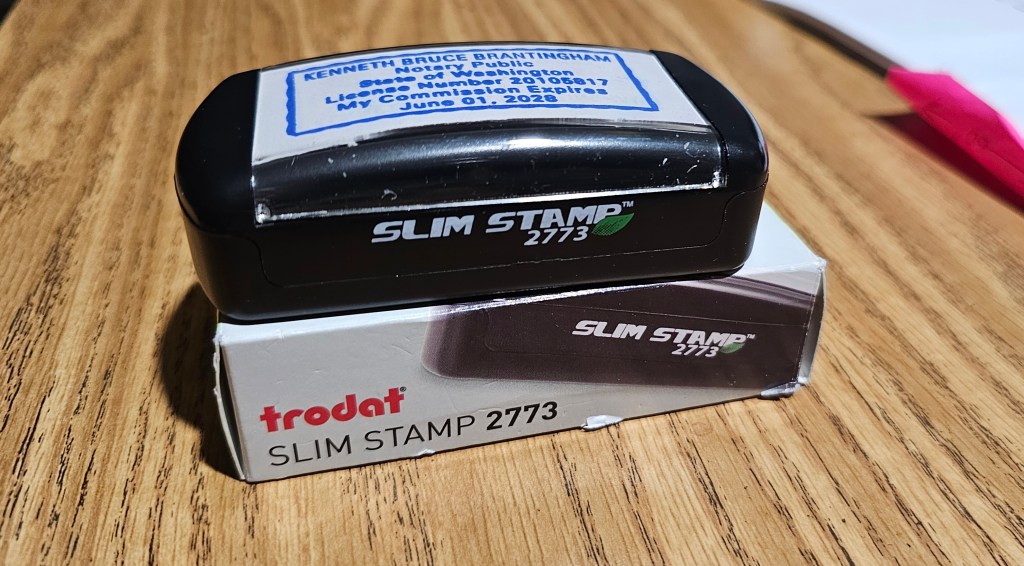
The Notary stamp

The stamp used in notarization can be ordered from many suppliers, including Amazon. It is necessary to provide the state’s license authorizing your notary commission. Some stamps are large and clumsy and some so small they’re made to be carried in your pocket. I prefer the latter. Mine is a Slim Stamp 2773. There’s even a Super Slim stamp. However, states have requirements for what is to be put on the stamp and the size of the font. A stamp that is too small will not be able to fit all the necessary information.

Expect to spend some good money on the stamp. Some go for under $20. Many, like mine, go for between $20 and $30 plus postage. Expect to use a vendor that you’ve never heard of. I’ve used Attorney Notary Supply of Washington and National Notary Association. For my renewal stamp I went with American Association of Notaries – https://www.notarypublicstamps.com/. They were quick and fairly priced. I also used Acorn Sales but had to back out of that order. Their turnaround time is very good and they are fair priced.

In ordering my renewal stamp I made double sure it conformed to the states requirements. In Washington State, they have requirements about the size of the lettering and what goes on the stamp. The requirements are as follows (Acording to WAC 308-30-070):

(1) The seal or stamp shall include the following information: (a) The words “notary public”; Certified on x/xx/xxxx (b) The words “state of Washington”; (c) The notary public’s name as commissioned; (d) The notary public’s commission expiration date; and (e) The notary public’s commission number.

(2) The type on this seal or stamp shall be a minimum of 8 point type.

(3) The seal or stamp shall conform to the following physical requirements: (a) The seal or stamp shall be minimum one and five-eighths inches diameter if circular, or one inch wide by one and five-eighths inches long if rectangular; (b) The face of the seal or stamp shall be permanently affixed; and (c) If the stamp is affixed to a tangible record, it shall be applied in permanent ink and shall be capable of being photocopied.

(4) The seal or stamp shall not contain the Washington state seal.

The stamp can’t be too small and have the required verbage. Strangely, it cannot have the proud and iconic Washington State seal.

Credible Witness

Identifying a signer is often a matter of producing a driver’s license or ID card. As long as it’s government issued and not more than three years expired (RCW 42.45.050). The notary can also verify that the signer is who they say they are through personal knowledge. A third way to identify a signer is through a credible witness.

Imagine having to sign an elderly person in an assisted living facility. They haven’t driven a car in years. Their driver’s license is long expired and they have no proper identification. And of course, you’ve never met them. The solution to legally identify them is through a Credible Witness.

This happened at a signing in an Assisted Living Facility. The State of Washington has a criteria for using a Credible Witness. It is as follows, according to RCW 42.45.050 (b)

By a verification on oath or affirmation of a credible witness personally appearing before the officer and personally known to the officer and who provides satisfactory evidence of his or her identity as described in (a) of this subsection.

When reading such laws with run-on sentences, keep an eye out for the word “and” or “or.” In this case the use of the word “and occurs twice. However, there are three requirements; 1) the credible witness must be present or “appearing” at your signing. They must provide evidence of their identity. After all, they may be required to testify at some later date. And finally, they have to be personally known to the officer or aka notary. In other words, you as the notary need to know them, and know them well enough and through dealings to be able to know they are who they say they are.

About that last part about knowing the Credible Witness – the Washington State Notary Handbook page 10 states, “Generally, you can rely on personal knowledge when you have known the individual a long enough time that you would be willing to swear in court as to who the signer is.” You have to have known them a long time.

What is a Settlement Statement?

I was taught to break out the Settlement Statement first in a signing. This form is used in purchases, sales, refinance, construction loans, and in both residential and commercial transactions. It’s everywhere and rightly so. This document breaks down all costs associated with the real estate transaction. We present this document first because issues are usually connected with the Settlement Statement, that and the Closing Disclosure. By far, the Settlement Statement is easier to understand because the numbers flow in columns as in an Excel spreadsheet.

At the top right I note if this is a buyer, seller, or refinance package. At top center is the name of the escrow company, the closer, and their office contact information. We’re also given the disbursement date which is the closing date. The buyer, seller, and property address is provided at the top. This top area is key to understanding who the players are, closing date and addresses.

The main body of the form usually has three columns. The first is the description column that provides a description of the line item being charged or credited. You may see the words Property Tax or Homeowners Association. Next to these titles are the proration dates and other values.

The two right side columns are debits and credits. The debits are the costs of the loan that correspond with the description in the first column. The last column to the right is the credit column. The sum of each column is at the bottom. Credits minus debits is the amount owed from signer or returned to them as proceeds. This is the second number from the bottom. If the number appears on the credit column, than the money is owned from the signer. If the amount is in the debit column, the money is owed back to the signer.

The Settlement Statement is typically signed. The buyer and seller Settlement Statements are quite different from each other. The seller typically is paying commissions; that shows up. Also the prorations are unique to the buyer or seller. The seller is probably also paying off a lender and leinable utilities.

The Settlement Statement form is product of American Land Title Association or ALTA. It can run one or two pages.

My script is as follows: “The first doc we’ll sign is the Settlement Statement. This is the title and escrow company’s version of the closing costs, itemized, with the money due back (or required from you) here, the second number up. We sign right here. When you’re ready.”

ALTA Seller Closing Statement

Note: I am not a lawyer and don’t give legal advise. This is meant to be a general description of the form to help notaries and others get acquainted with this form.

Certifying or attesting Birth certificates, Marriage, and Death Certificates

I received a call requesting to certify the photocopy of a birth certificate. Meaning that I would compare the original with the copy and certify that the copy was an exact copy of the original. Because a birth certificate is a public record, also known as a vital record, I cannot do this. This request must be made to the County Clerks office or the government agency that issued the document whether on the county or state level. They can issue a certified copy for a fee. This copy can be used for legal purposes.

Other vital records that cannot be certified by a notary include marriage licenses and death certificates.

Any government issued document should be researched as to whether a certified copy of the original should be made. A short list of problematic documents include state issued driver’s licenses and ID cards. Military ID, Social Security Cards, and Tax Returns. Add to the list Green cards, and Certificate of Naturalization and Certification of U.S. Citizenship, Certifying copies of school records is also prohibited by notaries. Certifying a copy of the identification page of a passport is acceptable in some states.

Do I need witnesses for my Power of Attorney notarization?

To answer this question, we need to go to the source document, the Revised Code of Washington, Title 11, Chapter 11.125, Section 11.125.050. Aka RCW 11.125.050 states:

“the signature must be either acknowledged before a notary public or other individual authorized by law to take acknowledgments, or attested by two or more competent witnesses”

The POA must be signed by the principal and either notarized by a notary or (not “and”) two witness. It’s an either/or answer.

Often the form will have an area for the notary to notarize. In addition there will be lines for witness signatures. The UPS Store will take one look at the lines for witness signatures and require two witnesses. According to RCW 11.125.050, a POA can be either notarized or witnessed. Ideally, the POA will have both.

Fee for a Notarial act

In Washington State the law states we can only charge $10 for most notarial acts, including attesting a signature, affirmations, and acknowledgements. WAC 308-30-220

The Notary is allowed to charge a travel fee in addition to the notarial fee as long as long as both parties agree to it. This agreement must be done in advance of the signing. https://app.leg.wa.gov/wac/default.aspx?cite=308-30-220

Identifying the Signing Party. A guide to Notaries and Loan Signing Agents

In Washington State there are three ways to identify the signing party (RCW 42.45.050)

1. Identifying documents – The most common method of verifying a signer’s identity is to look at some form of identifying documents. The Washington State notary statutes point out several options for documents that a notary can use to verify a signer’s identity:

A passport – Out of country ok.

A driver’s license – Out of state ok.

A government-issued identification card

Government identification must contain the signature or photograph of the individual and is satisfactory to the notary. A notary can accept any identifying document that is either current, or expired for less than three years.

2. Personal knowledge – If you personally know the signer, you do not need any additional identifying information. The notarial statute (RCW 42.45.050) says that a notarial officer “has personal knowledge of the identity of an individual appearing before the officer if the individual is personally known to the officer through dealings sufficient to provide reasonable certainty that the individual has the identity claimed.” Generally, you can rely on personal knowledge when you have known thee individual a long enough time that you would be willing to swear in court as to who the signer is.

3. Credible witnesses Identifying documents – . This is a more difficult standard, because it requires having a third party involved in the process. In order to use this method, a third-party witness must swear an oath and sign that the signing party to the document is who they say they are. The witness must be credible and personally known to you (see above on personal knowledge), and needs to provide identifying documents (see above on identifying documents) to prove their identity. Finally, both the signer and the witness must appear physically in front of you during the notarial act.

Sample Oath:

Oath: “”Do you (name of credible identifying witness)  swear that you personally know (name of document signer), that (he/she) is the person named in this document, that it is your reasonable belief that it would be very difficult or impossible for (him/her) to obtain an I.D. card for purposes of identification, that (he/she) does not possess an acceptable identification document; and that you are not financially involved or named in this document, So help you God?

Affirm: “”Do you (name of credible identifying witness) affirm on your honor that you personally know (name of document signer), that (he/she) is ther person named in this document, that it is your reasonable belief that it would be difficult or impossible for (him/her) to obtain an I.D. card for purposes of identification, that you do not have a financial interest, nor are you named in the document?”

Further reading from National Notary Assocation: Notary Essentials: Using credible identifying witnesses